ELKINGTON & Co. INNOVATION IN ART
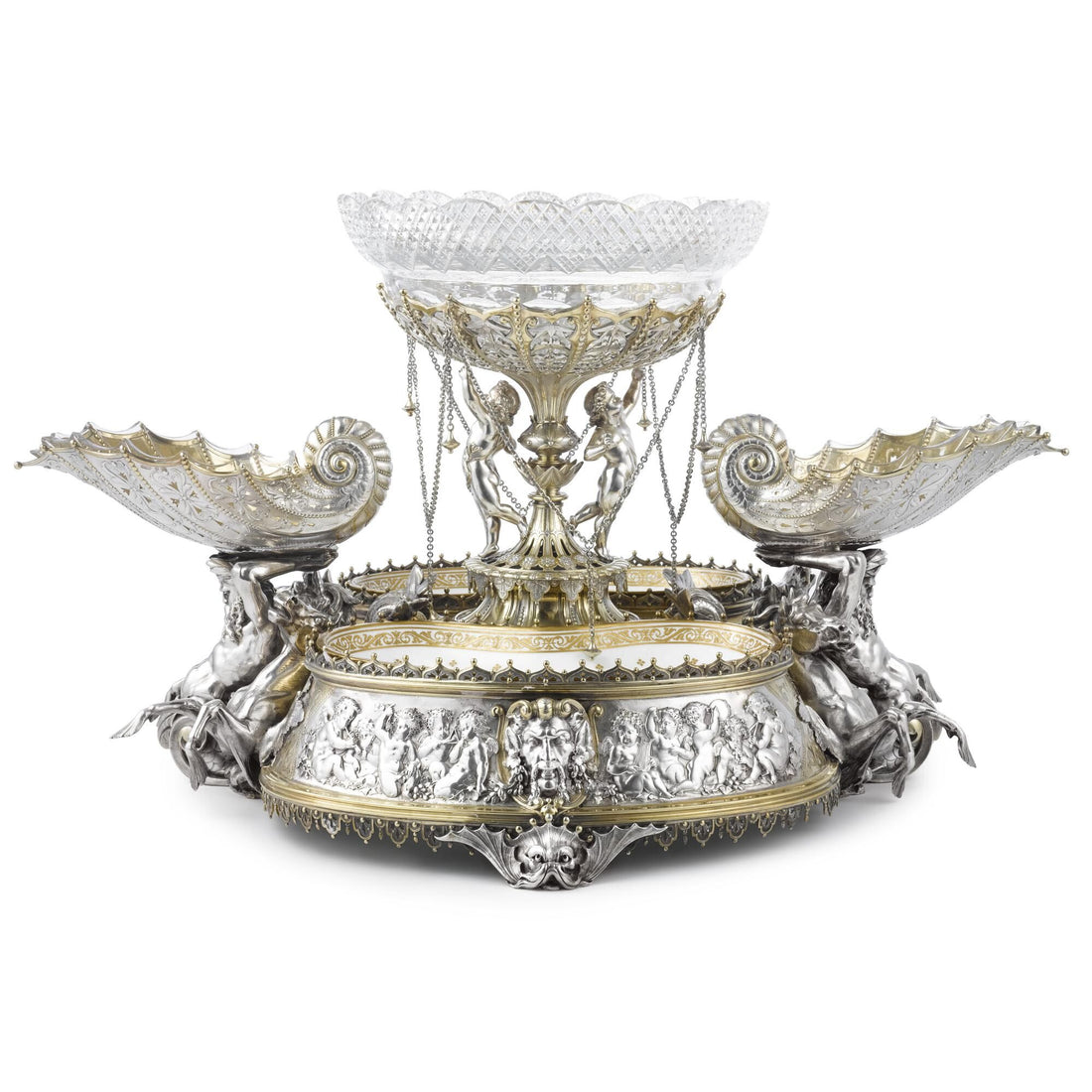
Elkington & Co was founded in 1824 by brothers George and Henry Elkington, and was one of the most famous English silverware and plate manufacturers.
In 1838 the brothers achieved success when they patented the galvanic technique that involved coating a thin layer of metal on the surface of a piece using electric current.
This process would catapult Elkington & Co. to worldwide recognition.
After changing the way silverware was made, Elkington & Co. grew exponentially by 1860, becoming the world's leading manufacturer of silverware.
Along with their new technique, the exceptional quality of their silver artifacts gained the attention of many and led them to receive countless commissions and awards.
The most important commission was from Queen Victoria. However, Elkington & Co. silverware was present at a variety of locations and events; from the women's singles trophy at Wimbledon to the tableware on the Titanic.
As the 19th century progressed, Elkington & Co. continued to exhibit its silverware, receiving the highest recognition for their extraordinary expertise, artistic skill and technological advancements.
Elkington & Co. Awards & Exhibitions
Elkington & Co. were honored with the Gold Medal of Excellence at the Great World Exhibition at the Crystal Palace, Hyde Park in 1851 where their exceptional artistry and innovative skill was celebrated.
As early as 1843, Prince Albert became a patron and collector, a tradition that continues to this day.
You can see the vast collection at the Victoria and Albert Museum which houses the world's largest collection of Elkington & Co. silverware in the Silver Galleries.
Elkington & Co. were influenced by a wide range of styles and designers. For example, after seeing a display of Japanese art at the Paris exhibition of 1862, Elkington & Co. cultivated a series of enamel wares influenced by Japanese designers and exhibited them at the Paris exhibition in 1867, as well as the Centennial Exhibition of Philadelphia in 1876.
Elkington & Co Designers and Collaborations
Some of the most important designers who worked for Elkington & Co. were Auguste-Adolphe Williams, Léonard Morel-Ladeuil and Christopher Dresser.
Auguste-Adolphe Willms was a French designer who collaborated with Elkington & Co. and had a prosperous relationship with them until her death. He was greatly inspired by medieval European, Islamic and Japanese art. Some of his most notable designs were of perfume burners, his vases and dishes.
Léonard Morel-Ladeuil was a French designer who remained with the Elkingtons for over 20 years.
One of his most notable works was “Milton Shield: Paradise Lost,” a steel and silver masterpiece that stole the show at the Paris Exposition.
Christopher Dresser, another designer in the 19th century, was greatly influenced by Japanese and abstract art. Known as "the father of industrial design", his designs for Elkington and Co. reflect his love of the botanical world. His works were analytical, scientific and full of absolute precision.
In his illustrious career for Elkington & Co., he provided designs for metals, ceramics, plates, glass and textiles.

Designer: Christopher Dresser, 1834-1904. Manufacturer: Elkington & Co.. c. 1899.
Elkington & Co.'s enormous influence is found throughout the world. From silver and electroplating to household tableware to art, their innovative experiments have allowed them to improve their techniques resulting in glorious objects.
1 comment
Ho trovato inciso su un vecchio RAC car badge, e , incuriosito, ho indagato.
Sono entusiasta di aver appreso della Vostra storia.
I miei comlimeti
Cordlamente
franco franchini